The Crosses: From Notes to Novel

As mentioned in earlier posts, Bonnie proposed in the late-2000s that we write a Holmes-universe-based novel. As her retirement from federal...

Friday, August 14, 2026

The Crosses: Getting the Historical Setting Right


This is the second of at least six posts on writing The Crosses. The third, discussing the novel’s character diversity, will be posted in a few days. If you haven’t followed the Kickstarter, please consider doing so at the link below. It will end later this month, so take advantage now to get not only the signed edition of the novel, but also other rewards that include:

  • Paperback, PDF, and Hardcover Editions
  • Signed paperbacks and hardcovers for USA fans
  • BSI Bundle that pairs The Crosses with Kim Krisco’s novel, Irregular Lives: The Untold Story of Sherlock Holmes and the Baker Street Irregulars.

https://tinyurl.com/3xed6txk

The Crosses: Getting the Historical Setting Right

Sherlock Holmes-related short stories and novels are usually set in Great Britain, but Bonnie felt our Baker Street Irregulars (BSI) novel should be set in the U.S. — specifically, in Las Cruces, the town to which we relocated upon Bonnie’s retirement from federal service. We knew extensive period and regional research would be required, but the possibilities intrigued us, from the desert terrain to its racial and cultural diversity, elements that would play important roles in any story we developed.

The challenge in writing historical fiction is getting language, social, and political aspects period-correct. For example, in the novel’s first draft, alcohol was readily available, but the story’s set in 1925, when religious zealots and conservative politicians held the key to the country’s liquor cabinet, forcing the novel’s characters to employ a bit of creativity in acquiring a brew or bottle of wine.

In 1849, a year after the U.S. acquired the region through the Treaty of Guadalupe, U.S. Army Lt. Delos Bennett established a settlement of 84 city blocks which he distributed lottery-style to settlers. He named the new community Las Cruces, based on an Apache-era legend that has no verifiable historical foundation, only oral tradition that recounts an Apache attack near the town’s founding site. Survivors purportedly marked the location with three wooden crosses — hence, the name Las Cruces, Spanish for The Crosses. Today, the symbol of three crosses is widely used by residents, businesses, and local government entities.

The town’s initial population numbered a little more than 100. By 1925, it had grown to a few thousand. The local newspaper, the Rio Grande Republican, began publishing in 1881 and, despite challenges over the years, evolved into today’s Gannett-owned Sun-News. The novel’s fictional newspaper, the Gazzette, however, is not based on the Republican, and its survival at the end of the book is in doubt.

The 1920s were a transitional, volatile period. Phone service was expanding, but problems associated with long-distance communication persisted, such as letters arriving after the upcoming events they addressed had passed. Radio had begun to compete somewhat with newspapers and live entertainment for consumer attention, mainly in large cities but not so much in smaller towns. The BSI, Ben Irwin, who’s from London, England, is accustomed to entertainment venues hosting everything from burlesque to Shakespearean plays. He’s pleasantly surprised when the newspaper’s publisher, Bessie de la Paz, takes him to the local theater for a traveling vaudeville production, featuring two comics he’s seen perform in New York.

The novel’s primary characters are a diverse group who must deal with open racism more strident than the resurgence we’re seeing today. While Ben is white European, Bessie — a former Pinkerton agent (Pinkerton employed women agents, but at a lower wage than males for the same job; sound familiar?) — is half indigenous-Mexican (her father) and white (her mother).

The deputy sheriff character, Orren Stokes, is inspired by Bass Reeves, a former slave who became a law enforcement officer in the Indian Territory and one of the first black Deputy U.S. Marshals, making more than 4,000 arrests and killing at least twenty men during his career. During the novel’s murder investigation, Ben is an eyewitness to the area’s blatant racism toward Native Americans, indigenous Mexicans, blacks, and “half-breeds.” (A future post will discuss primary character development in more depth.)

The field of medicine, especially in diagnosing and treating diseases such as cancer, was also experiencing rapid development. The novel’s good doctor, Walter Cain, is not only up on the latest medical information and treatment, he’s also the town’s coroner and self-taught expert in ballistics. He’s a pretty good guy with a compassionate bedside manner that proves more critical than the medications in treating terminal patients.

Local tribal and settler farms along the Rio Grande, which continues to be a primary irrigation source, provide the primary setting for the crime and action. Had we set the story a few years later, we would’ve had to contend with the Great Depression and, despite the Rio Grande’s use, dustbowl conditions. 

Prior, during, and after the Civil War, many Southerners, both pro- and anti-slavery, migrated to southern New Mexico. Many of those Southern whites, like Bess’s maternal grandparents, opposed slavery and secession, while others, like the family of Teri Johns, Bess’s employee and friend, supported the Confederacy. Other Southern migrants included African-Americans like Orren’s father, a former slave.

Another period consideration is language use such as slang and idioms. For example, politically influential people today have “clout.” In 1925, they had “pull.” Clout as political power or influence didn’t come into use until the 1950s. Every idiom, every expression, even vulgar phrases, required period verification.

These are only a few of the considerations required to create an authentic, believable setting. Upcoming blog posts will explore other aspects of the novel, including the characters’ ethnic and cultural diversity, their backgrounds, the crime that has brought them together, and the literary easter eggs interspersed throughout the novel. I hope you find the posts interesting. Thank you for coming along on the adventure.

Sunday, August 9, 2026

The Sherlock Holmes Connection to Las Cruces, NM


If you haven’t followed yet, please consider doing so. MX Publishing has launched The Crosses Kickstarter that includes not only the signed edition of the novel, but also other rewards that include:

  • Paperback, PDF, and Hardcover Editions
  • Signed paperbacks and hardcovers for USA fans
  • BSI Bundles


The BSI Bundle pairs The Crosses with Kim Krisco’s novel, Irregular Lives: The Untold Story of Sherlock Holmes and the Baker Street Irregulars.

Over the next few weeks, I’ll post several blog entries that detail various aspects of writing The Crosses. The first two, posted a few weeks ago, will be posted again, beginning with the entry below. Others will include how we developed the characters; the choice of historical setting and challenges it presented; hidden literary “easter eggs,” both personal and general, including an explanation of the desert cardinal photo posted with earlier announcements; and more. They’ll appear here on FB, but, if you want to receive them automatically, please visit my blog site at https://windpoemcreative.blogspot.com to subscribe to the RSS feed.


The Sherlock Holmes Connection to Las Cruces, NM


    “We should write a novel together.” With retirement approaching, Bonnie did not intend to slow down.

    “About?” I asked.

    “We could base it on a Baker Street Irregular (BSI) who’s now an adult and a renowned detective…”

    A lifelong fan of the Sherlock Holmes universe, both Conan Doyle’s original stories and those by writers since, Bon admired the street urchins Holmes occasionally employed to gather information. She suggested a BSI story set in the US could be a natural progression from the original stories.

    “And…?”

   “I’ll give it some thought.”

    And she did, filling a blue notebook with possibilities over ensuing years. 

    In 2015, Bonnie retired after three decades of federal service as a special agent for Defense Investigative Service, Defense Security Services, and Department of Army, a career she ended with a year’s service in security for NATO. As retirement neared, she began developing the potential BSI character, other characters, possible plot lines, and settings, incorporating events from her personal experience, such as the purported, but extremely suspicious, suicide of a coworker, and our planned move to Las Cruces, New Mexico, upon retirement.

    The novel wasn’t our only goal for retirement. We also planned to travel the world, which we expected would provide even more potential material for our BSI mystery. Two months after arriving in Las Cruces, those travel plans had to be placed on hold when doctors diagnosed Bonnie with endometrial cancer — luckily, stage one. A hysterectomy solved the problem, with no spread to surrounding tissues or lymph nodes. During the following months of monitoring checkups, we remained close to home, visiting only New Mexico destinations, all the while discussing novel possibilities. 

    As ideas began to coalesce into a possible storyline and doctors relegated medical checkups to a yearly basis, we again made travel plans. And again cancer put a stop to those plans, this time stage two/three colorectal cancer, which would require nearly two years of treatment, beginning with chemo and radiation, followed by surgery, followed by a second round of chemo. Meanwhile, Bonnie kept augmenting that notebook with possibilities.

    By 2020, the oncologist had declared her cancer-free — just in time for the pandemic. We continued developing ideas for the novel as Bon immersed herself in her two favorite creative skills, culinary arts and crochet, and I completed a literary project. By late 2021, an end to pandemic restrictions came into view as destinations beyond the horizon called. But…

    The cancer returned, this time stage four. We put aside the book and all other projects to concentrate on treatment and recovery. Nevertheless, despite the oncologist’s optimistic outlook of at least a five-year survival, chemotherapy proved ineffective, and the pain became excruciating. Bonnie passed away ten months after diagnosis.

    I buried myself in work, finishing several writing and music projects. Somewhere in there, I opened her notebook of ideas and heard her voice, excited, full of expectation and anticipation, as I read her words. And I realized I could keep her close by doing the very thing we’d planned to do — writing that book together.

    Three years later, The Crosses ~ A Baker Street Irregulars Mystery — set in 1925 Las Cruces, New Mexico, featuring a BSI, a female Native American-Caucasian newspaper publisher, and an African-American deputy sheriff, working together to solve the murders of three local tribal councillors — has been completed. Bonnie and I have done our best to make The Crosses a good read, an honorable entry into, and member of, the Sherlock Holmes universe. I’m deeply grateful to MX Publishing, the world’s largest publisher of Sherlock Holmes literature, for deeming it worthwhile.

    In the coming months, background posts will explore the novel’s historical setting, the characters’ racial diversity, the BSI’s background and circumstances that have brought him to the Southwest, and the literary “Easter eggs” interspersed throughout the novel, which I believe you’ll find interesting.

    I hope you’ll join me on this adventure as we realize together one of Bonnie’s goals, to write and publish an entertaining novel with human depth, The Crosses.

Saturday, August 8, 2026

Review of Sherlock Holmes and the Man Who Believed in Fairies by F.R. Maher


When fairy hoaxer, Dan Baines, asked F.R. Maher to give a presentation on fairies at a past Doomsday Gathering, UK’s annual event examining the strange and mysterious, it planted the seed for what would become a play and then a novel, both titled Sherlock Holmes and the Man Who Believed in Fairies. Maher began her presentation by asking, “What about the Cottingley Fairies?”— five photographs taken in 1917 by Elsie Wright and Frances Griffiths who lived in Cottingley, England. Although Sir Arthur Conan Doyle embraced the photos as incontrovertible evidence of fairy existence, the images were ultimately determined to be a hoax. When Maher researched the incident, however, certain questions arose about the initial investigation, questions that evolved into a clever Sherlock Holmes-based examination.

Blending fiction and reality, the novel’s plot revolves around the fairy scandal, pitting pragmatic Holmes against his fanciful creator, Doyle. Having recently reunited with John Watson as they enter the winter of their lives, Holmes is enraged, since his name is forever linked to Doyle’s, that Doyle has so publicly embraced the photographs as authentic. 

As Doyle becomes more entrenched in spiritualism and mystical belief, Holmes investigates the photographs to prove they’re part of an elaborate hoax to hoodwink both Doyle and the general public. The investigation leads Holmes to ponder life and death in terms uncommon for the detective, debating with himself as much as with Doyle’s position whether mystical possibilities can indeed be considered realities or if they can only be accepted on faith, subject only to individual perspective and conviction.

Sherlock Holmes and the Man Who Believed in Fairies offers a delightful exploration of the Cottingley Fairies hoax through the relationship of a rational fictional character and his more spiritual creator. The novel is available through Amazon.com, other booksellers, and directly from the publisher, MX Publishing.

Saturday, July 25, 2026

Morning Hymn now available

Morning Hymn is Chris's eighteenth album, his second featuring lyrical songs influenced by a number of musical styles and genres, from bluegrass and rock to jazz and indigenous flute music. Unlike his instrumental albums, Morning Hymn is based in the rock and singer-songwriter genres. Morning Hymn and all of his albums are available via most streaming and sales platforms, including Pandora, Deezer, Spotify, Amazon.com, Apple Music, and more, The album can be previewed in its entirety and purchased at http://csfuqua.bandcamp.com.


Monday, July 20, 2026

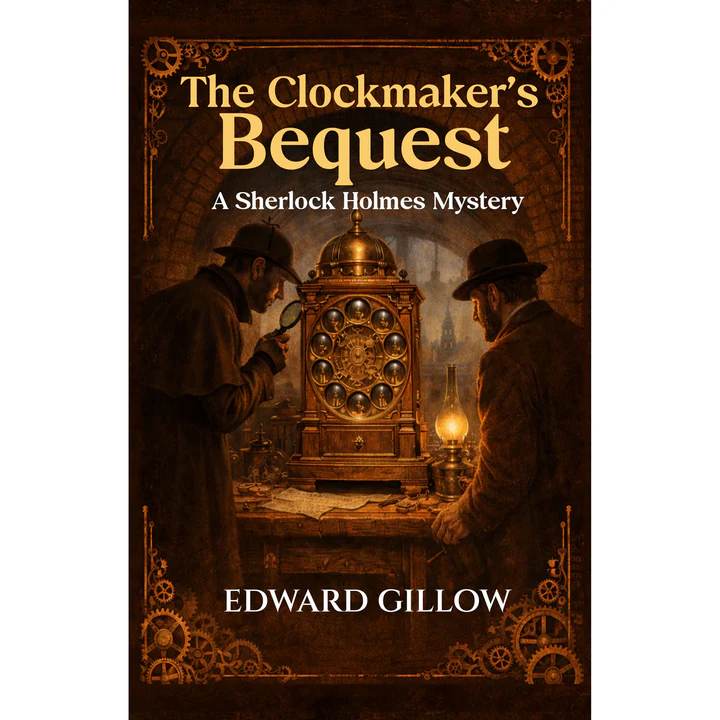
Review of Edward Gillow’s The Clockmaker’s Bequest


As Holmes and Watson languish in boredom, a telegram arrives from solicitor Phineas Larcombe, requesting Holmes’s immediate assistance. Renowned clockmaker Ezekiel Brand has died suspiciously after leaving his estate to whichever of his three apprentices can solve a riddle hidden in his final masterpiece clock.

Holmes examines the clock, which is housed in a secure vault. Since it’s light-sensitive and chimes a unique sequence of notes in darkness, Holmes deduces it’s designed to reveal a message under specific conditions rather than through physical tampering.

When one apprentice dies and another expresses fear for his own life, suspicion falls on Larcombe who may have reason to keep the clock’s secret undiscovered. In the event all apprentices die, Larcombe would become the clockmaker’s beneficiary, but Holmes suspects deeper motives driving events.

As Holmes and Watson continue to investigate, a letter arrives, warning them to abandon the investigation altogether. Instead, the duo attempt to prevent yet another murder by setting a trap for the murderer, spreading the rumor that Holmes has solved the clock’s secret, setting up the climax that unveils the murderer as well as the mastermind who set events in motion.

Author Edward Gillow perfectly captures the voice, mood, and pace of the original Holmes tales with this satisfying mystery worthy of the Baker Street detective’s expertise. The Clockmaker’s Bequest is available in hardback, paperback, digital, and audio formats from Amazon.com, other retailers, and directly from MX Publishing.

Thursday, July 9, 2026

The Further Memoirs of Sherlock Holmes Volume III, by Caiden Cooper Myles

The Further Memoirs of Sherlock Holmes Volume III, by Caiden Cooper Myles, features six new adventures and is a welcomed addition to the Holmes canon. Precisely capturing the original Holmes stories’ narrative voice and style, Myles delivers tales that not only further explore Holmes’s deductive prowess, but also celebrate his cherished relationship with John Watson.

Having finagled Holmes’s blessings to publish accounts previously forbidden, Watson recounts a half-dozen clever mysteries that include the disappearance of an Aztec statue, a mystical circle, the murder of a form
er criminal, a murdered politician, a gambler found garroted and naked in his study, and a nemesis worthy of Moriarty comparison, providing the intrigue and deductive challenges readers have come to expect Holmes and Watson to face.

Like Sir Arthur Conan Doyle’s stories, not all in this collection end neatly with the perpetrator suffering consequences for crimes committed. Holmes and Watson, to their frustration, must wait for future opportunities to serve justice even as an innocent in the meantime pays the price.

Myles has compiled a satisfying collection of tales, generously augmented with Victorian style illustrations by Marie-Charlotte Feret, that celebrate and honor Conan Doyle’s enduring legacy of “the world’s greatest detective.” The Further Memoirs of Sherlock Holmes Volume III is available in hardback, paperback, digital, and audio formats from Amazon.com, other retailers, and directly from MX Publishing.


Monday, March 20, 2023

The Bridge & Politics Published


Announcing simultaneous publication of two books, The Bridge and Politics. In late 2021, it became necessary to place all work on hold throughout 2022. I have now returned to those projects, which means more will appear in a shorter time than usual, beginning with these two collections, but I will not inundate you with emails. I hope you find the completed projects interesting and relatable.

The Bridge and Politics collect new and previously published poems that present the stories of life's common and extraordinary experiences we share in myriad ways. The books are available through most bookstores in digital and paperback formats, including Amazon, iTunes, Kobo, Barnes & Noble, and many others. You can also request your local library to purchase them through distributors such as OverDrive.

In tribute to my best friend and spouse Bonnie, I am currently posting previously published poems to FaceBook (http://facebook.com/c.s.fuqua.author), poems that will be included in an upcoming collection tentatively entitled Bonnie Lynne ~ Real Love Poems, featuring new and collected poems written for and/or inspired by Bonnie over our 5-plus decades together. Other upcoming projects include a tribute album of songs and instrumentals written for Bonnie over the years. I hope you’ll find each project a celebration of and testament to one of the most extraordinary persons ever to grace this planet.

Praise for C.S. Fuqua’s poetry:

  • C.S. Fuqua’s poetry paints an entire story with a Tom Waits brush. If you don’t know what I’m talking about, google it. ~ Ken S., editor, Spank the Carp literary magazine
  • With an eye for the particular and ear for the music of life, C.S. Fuqua shares with readers his brave, lyrical view of the human experience. ~ Dr. Wendy Galgan, former editor, Assisi Literary Magazine
  • … gritty, insightful, humorous, tragic, and celebratory … ~ Jonathan K. Rice, editor, Iodine Poetry Journal
  • C.S. Fuqua handles the themes of love and death with beautiful simplicity: what else is there to life? ~ Kalyna Review
  • …thought-provoking and interesting … ~ Suanne Schafer, author, A Different Kind of Fire
  • …a lasting impression on the reader. ~ Sensawunda
  • The power of C.S. Fuqua’s poetry lies in the relentless chronicling of real people with real sorrow, triumph, regret, and above all the sad beauty of the human experience. Superb poetry. ~ Tony Nesca, Author of About A Girl
  • Few have as deft a touch as C.S. Fuqua, weaving a complete story in just a few lines—what poetry is supposed to be. ~ Dick Claassen, Author of Sacred Native American Flute

I am grateful for your support of and interest in my work. If you have questions or concerns, please visit my websites (csfuqua.com and csfuqua.bandcamp.com) or write to me directly at fuqua.cs@gmail.com. 

I wish you and your loved ones the very best always.