The Crosses: From Notes to Novel

As mentioned in earlier posts, Bonnie proposed in the late-2000s that we write a Holmes-universe-based novel. As her retirement from federal...

Thursday, September 24, 2026

Shadow of the Storm ~ Missing Chapters & New Ending

Not long after Rob passed away, his brother, David, who’d served as liaison during Rob’s last days, mailed to me the notes Rob had made regarding overall plot and the new ending. I already had the novel’s first draft except for the missing final three chapters. The task ahead would be to reconstruct those lost
An excerpt from Rob's final notes regarding the novel's ending.

chapters and direct the plot to the new ending Rob had envisioned in his last hours.

Rather than tackling reconstruction of the chapters immediately, I revised what I had in hand, paring down the existing draft from 140,000+ words to a more manageable and publisher-preferred word count for novels. By the time I finished revising the existing chapters, I was fully refreshed on where the plot was headed and how to steer it to Rob’s new ending. To my delight, crafting the new chapters went rather quickly. Throughout writing the first draft, Rob and I debated various plot and character aspects, fully establishing his point of view and voice in my psyche. It was not surprising as I reconstructed the missing chapters to hear him in my mind, either objecting to or approving the direction the story was taking. In the end, we landed exactly where he’d indicated in his final notes the book should end.

Shortly before he lost his voice during hospice care, Rob assured me that he’d found peace with his life—the good, the bad, the in-between. “Sure,” he said one of the last times we talked, “I’d change some things if I could, but we don’t get to do that. And we don’t get to change whatever may lie ahead. We can influence the future, but what’s gonna happen’s gonna happen.” He sighed. “I won’t be going home, Chris. But let me tell you, I’ve had a good life—good friends, great family. Now I have cancer. Everyone dies. It is what it is.” He chuckled softly. “Piss on it.” 

No self-pity. No remorse. Only acceptance and truth. The past is gone. The future is something that may or may not occur. We control neither. All we have is the moment. Rob learned how to use the moment to its potential right up to the end. One result is Shadow of the Storm, a darn good story with meaning.

Societal fear and unrest on Earth have skyrocketed due to increasingly bizarre and destructive events around the globe. A team of the world’s top physicists, working for America’s ruling corporation, Nattech Inc., has determined that future-based “time ripples” are triggering the events. Nattech enlists Cheyenne Native Americans Wolfshadow and Sarah Boone to track down and eliminate the source of those ripples, an other-dimensional, megalomaniacal, narcissistic entity known as Mahu, whose twisted goal is to rule a gutted Earth.

Shadow of the Storm is slated for publication mid-October 2026 from Foolscap & Quill. Stop by Foolscap at https://www.foolscap-quill.com/ for an array of exceptional novels in various genres. Upcoming posts will explore other characters and the novel’s long journey to publication. Receive posts automatically by visiting https://windpoemcreative.blogspot.com to subscribe via the RSS feed. For more information about my work, especially the latest novel, The Crosses ~ A Baker Street Irregulars Mystery, written with my late spouse, Bonnie Del Aguila, available from MX Publishing and most bookstores, please visit https://csfuqua.com.


Thursday, September 17, 2026

James Pleasant Wolfshadow

Whether Rob planned it or not, I’ll never know, but James Pleasant Wolfshadow came to embody many of his creator’s qualities even in the first draft—determination, loyalty, duty, humility, forgiveness, acceptance, and compassion. By the time he pitched the idea to cowrite a science fantasy novel featuring a Native American protagonist, set in a dystopian future that our present resembles more each day, Rob Graham had worked out most plot and character details that would guide first-draft writing. 


Jim Wolfshadow is a former special ops agent who retired to apply his clandestine abilities for America’s ruling corporation, Nattech. After his wife dies in a terrorist attack most likely designed to take him out, Wolfshadow retires into seclusion, guilt-ridden and struggling to find redemption, confiding in only one person, his lifelong friend and occasional lover, Sarah Little Bird Boone.

Wolfshadow’s guilt over his wife’s death is based on a love so deep and primal that he cannot forgive himself even though he had no control over events. Wolfshadow’s devotion is a reflection of Rob’s deep love for his former wife, Teri. To honor her, he named Wolfshadow’s wife Teri. As Rob’s alcohol addiction worsened, his relationship with Teri deteriorated to the point she could no longer remain with him. They divorced, and his addiction and decline continued until he hit bottom, losing everything, ending up on the street, scrounging from garbage bins to stay alive until that morning when an especially awe-inspiring sunrise provided the epiphany and clarity he needed to change his life. The moment proved one of Rob’s most spiritual, if not the most, and he dedicated himself to kicking alcohol and rebuilding his life. He began to explore his spiritual side, reflected in the meditative practices employed by Wolfshadow and Little Bird. His affection for his former wife never waned as he harbored the unlikely hope that he would one day reunite with her.

Rob lived in Texas, and I in Alabama. He didn’t like computers, instead writing detailed outlines in longhand, which he would then flesh out via hunt-and-peck typing on an old typewriter. He’d mail the first-draft chapters to me to revise. I’d then send them back. Chapter by chapter, back and forth. It proved time-consuming, of course, but it also enabled us to consider more closely the plot and characters, especially as he explored the mythologies of religions from around the world, something that affected his personal outlook and beliefs as well as Wolfshadow’s. 

To support himself, Rob worked as a server for a family steakhouse, earning about $2.50 an hour plus tips. He busted his ass for a pittance on which he could barely survive. The job included no benefits, certainly no health insurance. When Rob developed worsening pain in his throat, he delayed a medical checkup until he could no longer bear it. It turned out to be cancer. He began to decline somewhat physically, but continued to work even as he struggled to pay for treatment, eventually securing some assistance from the state. The cancer appeared to go into remission, but that was short-lived. Eventually, he lost his job and ability to pay for treatment. The cancer spread. The pain increased. He could not afford the exorbitant costs of medication, but he could afford a bottle of cheap alcohol, and that helped deaden the pain. It also rekindled his addiction. 

Progress on the novel slowed until it stopped completely. We’d finished the first draft and had begun the second, but the last three chapters of the first draft and all of the second draft, for whatever reason, went missing. The cancer worsened, along with his consumption of alcohol, until Rob finally arranged a deal with a teaching university to provide palliative care in exchange for the donation of his body for study upon his death. In care, he again kicked alcohol, but his physical decline continued at an increasing rate as the cancer spread. 


Nevertheless, he expressed a desire to get back to the novel, but the missing chapters were an issue. We talked at least once a week, his growing weakness evident in his voice. I encouraged him to write what he could recall of the chapters, that I would flesh them out. He promised he would, but he simply didn’t have the energy.

Near the end, he grew too weak to communicate with me via letter or phone. His brother David became our go-between, urging Rob to scribble whatever he could about the chapters, which would then be passed on to me. David’s encouragement had two purposes—to press Rob to complete his final creative dream, and to distract him from the painful decline he was experiencing. Two days before he passed away, Rob wrote several lines on the yellow notepad, tapped it with the pencil, and told David that I would understand what he’d written was the end, that he’d leave me to fill in the missing chapters leading up to this new ending. Over the next two years, that’s what I did, along with revising the novel numerous times until it  eventually became the completed Shadow of the Storm in which Wolfshadow seeks self-forgiveness and understanding regarding the death of his wife, much like Rob had in life. 

Soon after entering the palliative care facility, Rob contacted Teri. They had the conversation he had imagined many times before, deep, reflective, and affirming, affording him some peace despite his regret that life had not been different. But isn’t that the way we all end up, wishing we had been better, had made different choices, that we had shaped ourselves in a far more constructive, compassionate way, that the life we live actually has meaning? Thing is, Rob’s life did have meaning. And much of that truly meaningful life is reflected in the character of James Pleasant Wolfshadow.

Upcoming posts will explore other characters, revisions based on Rob’s final directions, and the novel’s long journey to publication. Receive posts automatically by visiting https://windpoemcreative.blogspot.com to subscribe via the RSS feed. In the meantime, please stop by Foolscap at https://www.foolscap-quill.com/ for an array of exceptional novels in various genres. For more information about my work, especially the latest novel, The Crosses ~ A Baker Street Irregulars Mystery, written with my late spouse, Bonnie Del Aguila, available from MX Publishing and most bookstores, please visit https://csfuqua.com.

Thursday, September 10, 2026

Piss on It ~ Shadow of the Storm’s Genesis


    Optimism defined Robert Edward Graham. He’d greet the day with the conviction that, no matter what it threw at him, it would place him closer to goals he was determined to reach. I don’t know if he’d always been such a man, but it was certainly the man who’d overcome alcohol addiction and homelessness, who’d found his strength in a soul-moving sunrise to rebuild his life.

    Born in 1945 in Corsicana, Texas, Rob became an all-state tackle in high school during his team’s 1963 winning season and post-season state football championship victory. While many of his classmates entered college after graduation, Rob took off in an artistic direction with an eye on the big time. As he did with every endeavor, he prepared relentlessly until he felt he was ready. Then he went for the primary goal, not a hundred smaller goals that might or might not lead to the big one.

    He ventured first into music as a founding member of the Penthouse 5, a rock garage band that became a regional sensation in the mid-1960s. Rob served as primary songwriter and vocalist. Penthouse 5 quickly became known for blending vocal harmonies with increasingly heavier music to create something new and exciting. The band cut several singles for regional labels, one reaching number one in the Dallas market, bringing the group to the cusp of national success. (The band’s album, The WordD is Love, is on YouTube at https://www.youtube.com/watch?v=ehElqibg0TE&list=RDehElqibg0TE&start_radio=1.) But rifts developed between several of the members, and the group split in 1967. Due to copyright ownership shenanigans by one of the members, Rob never received any royalties for the songs he wrote.

    “Piss on it.”

    That phrase became his trademark. Whenever life didn’t go quite the way he wanted or landed wide of his target, he’d shrug it off with a hearty “piss on it.” He’d laugh and move on—sometimes to better things, sometimes to worse.

    After Penthouse 5 split, Rob pursued acting, appearing in commercials and regional stage productions. To supplement his income and further expose himself to potential acting opportunities, he relied on his rugged good looks to become a popular male model, remaining in high demand for several years. Such demand provided ample opportunities to indulge in various vices, and Rob chose alcohol. At first, he limited consumption to social engagements, but then he began to drink heavily and regularly in private as well, developing a strong alcohol dependency that destroyed several close relationships. Job offers dried up. His wife left him. Eventually, he wound up on the street, surviving on what he could scrounge from restaurant garbage bins.

  “Then one morning,” he confided, “I woke beside a dumpster with my face in a puddle of vomit. The sky was on fire with the rising sun. At that moment, I had an epiphany. I had two choices—die or get sober. Piss on it.” 

    He checked himself into a detox center and spent the next desperate months getting straight. He’d been clean for a couple of years when he enrolled in Writer’s Digest School’s short fiction course, and the school assigned him to me. For whatever reason, he found it easy to work with and confide in me, and we developed a deep friendship that led to the creation of James Pleasant Wolfshadow, Sarah Little Bird Boone, and the odyssey that culminates this October with Foolscap & Quill’s publication of Shadow of the Storm. 

    Upcoming posts will explore the development of the novel’s plot and characters, Rob’s final tragedy, and the eventual realization of his dream to become a published author. You can receive posts automatically by visiting https://windpoemcreative.blogspot.com to subscribe via the RSS feed. In the meantime, please stop by Foolscap at https://www.foolscap-quill.com/ for an array of exceptional novels in various genres. For more information about my work, especially the latest novel, The Crosses ~ A Baker Street Irregulars Mystery, written with my late spouse, Bonnie Del Aguila, please visit https://csfuqua.com.


Tuesday, September 8, 2026

The Crosses: From Notes to Novel

As mentioned in earlier posts, Bonnie proposed in the late-2000s that we write a Holmes-universe-based novel. As her retirement from federal service approached, she diligently documented various possibilities, characters, historical events, and more, meticulously organizing them in a compact blue notebook. Following her retirement, she continued compiling notes even as she dealt with recurring cancer that ultimately claimed her life in 2022.

In previous posts, I have alluded to certain aspects of characters and plot based on her notes. Today, I’m including images of actual samples from her notebook. Upon reading the novel, you will likely realize connections between the notes and how they shaped the plot and character development.

Weeks after her passing, I began reading the notes, and I could hear her voice distinctly, brimming with excitement and anticipation. It was time to begin. I felt a profound sense of connection to her by engaging in the very endeavor we had envisioned—writing that book together. In April of this year, a little more than three years after her passing, The Crosses ~ A Baker Street Irregulars Mystery was a reality, and I began the submission process. I anticipated the customary fluctuations in consideration and rejection that can persist for months and even years. However, consideration of The Crosses proved exceptional—the swiftest book acceptance in my career and by the most suitable publisher, MX Publishing, the global leader in Sherlock Holmes-related literature.

Set in 1925 Las Cruces, New Mexico, The Crosses delves into the investigation of the murders of three tribal councilors, which has stalled due to accusations of racial bias. When newspaper publisher Bessie de la Paz seeks guidance to revive the investigation, former Baker Street Irregular Ben Irwin arrives to assist her and the investigating deputy sheriff in tracking down the perpetrator. The investigation culminates in a fourth death that leads to the killer but erodes Bessie’s trust in those once closest to her as she increasingly relies on Ben for more than she anticipated.

The Crosses is a fitting memorial to Bonnie, a novel she coauthored in honor of one of her literary heroes and the genre she cherished most. I am grateful to MX Publishing for bringing her vision to a worldwide audience. Additionally, I extend deep gratitude to you and every reader for your interest. The Crosses is available in hardcover, paperback, and digital formats from MX Publishing, Amazon.com, Barnes & Noble, and other book retailers.

Friday, September 4, 2026

The Seed for Shadow of the Storm

Posts leading up to Foolscap & Quill’s mid-October publication of Shadow of the Storm will explore the novel’s genesis and introduce co-writer Rob Graham, whose idea became an extraordinary tale of greed, hate, cruelty, compassion, and selflessness. A big thank you to Foolscap & Quill for enabling Rob’s dream finally to be realized. I’m certain he’s grinning with delight and satisfaction as he strolls his idea of heaven, the Elysian Fields.

The Seed for Shadow of the Storm

During the mid-1990s, I was an instructor for Writer’s Digest School’s short-fiction writing course. The mail order course comprised several lessons that covered idea generation, plot development, setting, and character creation and development. The majority of students were hobbyists while the more serious were beginning their writing journey. One of the students in the latter group was Robert Edward Graham.

Through our correspondence, Rob and I gradually developed a friendship. When he requested a phone call, that he had a proposal to make, I explained we’d have to wait until after he’d completed the course due to school regulations regarding student-teacher contact. When we connected after the course, I discovered him to be an intriguing, optimistic, compassionate, and deeply introspective individual with a wickedly funny sense of humor. We solidified the friendship swiftly and became entangled in each other’s lives as friends do.

He shared with me his experiences growing up in Texas, playing high school football for the state championship team, foregoing college to form a regionally popular band, pursue acting and modeling careers, marry the woman he’d love his entire life, and become immersed in the destructive glamor of his life — until he lost everything to alcoholism, resulting in divorce and eventual homelessness. These experiences will be detailed in a later post. 

After a sunrise epiphany as he awoke in a gutter and vomit, he entered rehabilitation, got himself clean, secured a job as a restaurant server, and began rebuilding his life. Now he wanted to explore his potential as a writer, demonstrating a talent uncommon among most students who enrolled in the course. I urged him to
revise some of the stories he’d written for the course and submit them to magazines to learn the industry and establish himself. 

“I don’t have the time for that,” he scoffed with a laugh. Neither of us realized the gravity of those words. “I have an idea for a novel. But I need some help, someone who knows the ins-and-outs, someone I can trust as a co-writer. You’re that person. Together, I think we can write a winner.”

Thus commenced our collaboration, the creation of James Pleasant Wolfshadow and the odyssey that culminates this October with the the publication of Shadow of the Storm from Foolscap & Quill. What an extraordinary journey it has been, a journey subsequent posts will explore. In the meantime, please stop by Foolscap at https://www.foolscap-quill.com/ for an array of excellent fiction in various genres. For more information about my work, especially the latest novel The Crosses ~ A Baker Street Irregulars Mystery, written with my late spouse, Bonnie, please visit https://csfuqua.com.

Wednesday, August 26, 2026

The Crosses’ Easter Eggs


If you haven’t followed the Kickstarter, please consider doing so at the link below. It will end in five days, so take advantage now to get the signed edition and other rewards that include:

  • Paperback, PDF, and Hardcover Editions
  • Signed paperbacks and hardcovers for USA fans
  • BSI Bundle that pairs The Crosses with Kim Krisco’s novel, Irregular Lives: The Untold Story of Sherlock Holmes and the Baker Street Irregulars.

The Crosses’ Easter Eggs

Authors often insert subtle references known as literary Easter eggs into their stories for a number of reasons — to enrich the tale with hidden references or symbols; to add depth by alluding to works of literature, music, culture, or personal experience; to connect to broader themes; and, sometimes, to engage in a game between author and reader. We intentionally included several Easter eggs in The Crosses.

One reference involves the Baker Street Irregular. Bonnie decided his initials should be the same as his former gang’s acronym, BSI. Researching popular names of the time, we decided on Benjamin Scott Irwin, choosing “Benjamin" also to honor Bonnie’s father, Edward Benjamin Del Aguila, a former Navy pilot, who died in 1972 when wind shear slammed his jet into the tarmac during an Air National Guard training flight.

Bessie de la Paz, the novel’s heroine, is the object of several references. Bess’s mother is of European descent, while her father is indigenous Mexican, that background mirroring Bonnie’s own genealogical history. Bonnie’s maternal line is European. Her paternal line includes the indigenous Mexican Zecatecas people. And, yes, Bessie resembles Bonnie physically — small in stature but formidable. Similarities don’t end there. Bess’s determination, honesty, dedication, optimism, humor — all inspired by Bonnie. Bess and Bonnie are linked loosely by careers as well. Bess is a former agent for Pinkerton. Bonnie spent nearly three decades as a federal special agent. Both are experts in law-and-order and are guided by high ethical and moral standards. Further, they have the same initials, BLD — Bessie Laine de la Paz, Bonnie Lynne Del Aguila.

Bonnie’s love of mysteries — especially her devotion to Sherlock Holmes and Agatha Christie’s characters, Hercule Poirot and Miss Marple — is legend among those who know her. The book pays tribute to that love of mystery when Bess remarks to Ben that Holmes’s methods are similar to Hercule Poirot’s. Ben quips, “Yes, but Poirot is fiction. Mr. Holmes is real,” a remark that would generate a roll of the eyes from both Bess and Bonnie. Other Easter eggs link Bess and Bon as well, but I’ll leave those for you to find.

One reference involves the secondary character, Teri Johns. Teri’s family claims her death is suicide, but circumstantial evidence suggests otherwise. Her death and circumstances were inspired by the purported suicide of one of Bonnie’s colleagues. Though suspicious — from the method, to the person’s excited anticipation of specific future events, to the known animosity between her and her immediate relatives, especially her mother — Bonnie’s friend’s death was never investigated beyond the assumption of suicide.

We titled the book The Crosses for several reasons. Las Cruces, the novel’s setting, translates from the Spanish as “The Crosses,” the name based on a legend that’s recounted in the book. The cover itself is based on a photo that Bess shoots to illustrate an article on the murders. A tribal cemetery is maintained beside the dilapidated tribal council hall. Crosses have been erected over the murdered councillors’ graves. The framed shot features the crosses and council building in silhouette against a sky illuminated by the setting sun, a symbol for the approaching end of life. 

Before the publisher completed the book’s cover design, I posted a photo of a desert cardinal in connection with the story. Birds are referenced several times in the book, each symbolic. The first reference comes in the prologue when the young girl who discovers the bodies arrives at the tribal council hall. A burrowing owl is perched on the roof above the door. Burrowing owls in some Southwestern native cultures are often associated with wisdom and protection but are considered a bad omen if witnessed during daylight hours. The girl spots it at dusk, a time when its mystical meaning is murky at best. 

A desert cardinal appears twice in the novel, at the beginning with the owl and near the end, described at one point as having blue and orange plumage, although most have blue and red plumage. The colors are so rich and vibrant, that the red sometimes appears orange. Their plumage symbolizes life, energy, and a connection to the spiritual realm. The photo I posted with earlier announcements is one I shot of the only desert cardinal I’ve seen in the twelve years I’ve lived in southern New Mexico. On Bonnie’s birthday following her passing, I hiked a canyon that she and I had planned to hike together. As I started out, I heard a beautiful birdsong and spotted the cardinal in a small, spare tree about thirty yards away. I was afraid that readying my camera would scare it away, but it simply looked at me and kept singing.

I later learned that the desert cardinal has significant spiritual meaning within many indigenous cultures. I had never seen one before that day. I haven’t seen one since. Near the end of the novel, in a letter to John Watson, Ben writes, “A bird on the windowsill across the room is singing the most beautiful song. I have learned that it is a desert cardinal. Native people believe these birds embody deceased loved ones who return briefly to reassure those left behind that all is well. It’s a comforting myth, one I wish I could accept. Alas, a bird is a bird.”

These are a few of the primary Easter eggs scattered throughout the novel. There are more, but I’ll leave them for you to find.

Now that you know some of the background on writing The Crosses, we hope you enjoy the story. Thank you much for coming along with us. The Crosses will soon be available through Amazon, B&N, other booksellers, and directly from the publisher, MX Publishing.

Monday, August 24, 2026

Plotting According to History


This is the fifth post on The Crosses. The sixth will be posted in a couple of days, detailing many of the literary easter eggs that appear throughout the novel, including an explanation of the desert cardinal photo I’ve posted previously in connection with the novel. Receive posts automatically by visiting https://windpoemcreative.blogspot.com to subscribe to the RSS feed.

If you haven’t followed the Kickstarter, please consider doing so at the link below. It ends this week, so take advantage now to get the signed edition and other rewards that include:

  • Paperback, PDF, and Hardcover Editions
  • Signed paperbacks and hardcovers for USA fans
  • BSI Bundle that pairs The Crosses with Kim Krisco’s novel, Irregular Lives: The Untold Story of Sherlock Holmes and the Baker Street Irregulars.


Plotting According to History


The Crosses is an historical mystery, requiring attention to the smallest of historical details, including use of electricity, proliferation of automobiles, changing methods of communication, state of medicine, social evolution, forensic methodology, language use, and idiomatic expressions no longer in use, to name only a few. The novel opens with the discovery of three local tribal councilors, shot to death, no one around except the young girl who finds them. The tribal council building is remotely located near the Rio Grande, southeast of Las Cruces, New Mexico. After the initial investigation by the county’s deputy, Orren Stokes, the inquiry stagnates due to the lack of witnesses and physical clues.

The technological aspects of the period heavily influenced the plot, but the most influential factors were racial and cultural. Bessie de la Paz, newspaper publisher and former Pinkerton agent, has been assisting Stokes in the investigation as best she can. Although her father had been a tribal member, her mother’s white. The tribe scorns her because she is mixed-race, which makes her investigative attempts even more challenging. Frustrated, she writes in request of advice to the former Baker Street Irregular, Ben Irwin, who has become a renowned detective, following in the footsteps of his mentor, Sherlock Holmes.

Dr. John Watson notifies her that he has forwarded her letter to Irwin, already in the U.S. on another matter involving a former BSI leader now engaged in international crime. With plans to travel to the Southwest regarding the former BSI leader, Irwin arrives in Las Cruces to offer whatever assistance he can. Amid accusations of racial prejudice in the murders and the failure to solve them, the investigating trio uncovers new clues while Ben and Bess grow emotionally close as Bess confronts the biggest challenge of her life.

Although the story’s native tribe is fictional, elements are based on area tribal life in the late 1800s and early 1900s. Racism of the time affected every aspect of life, especially when events crossed cultural lines. The potential for racial conflict escalates when tribal councillors, who’ve been at odds with the area’s white farmers, are murdered. While the investigation must deal with racial prejudice against indigenous and black Americans, the investigators nevertheless focus on solving the crime, no matter where it leads.

Bonnie and I intended The Crosses to honor the Holmes tradition, but we wanted to take it beyond Holmes and the typical British setting by featuring a character directly influenced by the celebrated detective, a character who brings Holmes’s methods to America. Above all, we wanted to write an entertaining story of intrigue and humanity, one that readers will enjoy.

The final post will explore the literary easter eggs scattered through novel. Blog entries appear on https://windpoemcreative.blogspot.com, https://csfuqua.com/blog, Goodreads, and Facebook. Thank you much for reading. The Crosses is available from Amazon, B&N, other booksellers, and directly from the publisher, MX Publishing.

Thursday, August 20, 2026

Fleshing Out Primary Characters in The Crosses


This is the fourth background post on The Crosses. If you’d like to receive posts automatically, please visit https://windpoemcreative.blogspot.com to subscribe to the RSS feed.

If you haven’t followed the Kickstarter, please follow at the link below. It ends soon, so take advantage to get not only the signed edition of the novel, but also other rewards.

https://tinyurl.com/3xed6txk

Fleshing Out Primary Characters in The Crosses

Writers often refer to their characters as real — because they are, at least in our minds. Characters embody traits of acquaintances, friends, relatives, and even ourselves that make them far more than a collection of words on a page. 

An earlier post provided basic information about The Crosses’ main characters, including the deputy sheriff, Orren Stokes, son of a former slave, proficient in several indigenous languages, a former Pinkerton agent. From those background bullet points, a reader can surmise that Orren’s determined and dedicated, a man with the grit and will to accomplish what others would find impossible. 

Orren’s a big man, but calm, patient, and occasionally looks at life’s situations with the knowing humor of one who’s lived through much worse. While he’ll make minor compromises to further his goals, he refuses to be abused by those who possess “entitled” power. He examines a situation and the facts thoroughly before taking action. He’s soft-spoken and always has in mind the best interests of all involved. He’s deductive, patient, and, most of all, loyal to those he calls friend. Although his basic persona’s inspired by real-life lawman, Bass Reeves, the qualities that make Orren human, that make him real are based on a dear friend, truly a brother to Bonnie and me, someone we’ve known, trusted, and loved since Bonnie and I met at age 15. But I won’t embarrass him by naming him here.

An important secondary character, Teri Johns, is loosely based on one of Bonnie’s former colleagues. Teri shuns many social norms of the past in favor of progress. She’s emotionally stronger than her brothers, publicly affable, extremely dependable, trustworthy, and determined, but occasionally timid. And like Bonnie’s colleague, Teri’s life proves tragic. 

Our Baker Street Irregular (BSI), Ben Irwin, isn’t based on anyone in particular. Instead, he’s a combination of men and women Bon and I have known, with a smidgen of ourselves thrown in. He’s small but indomitable, certainly able to defend himself against physical threats as he readily demonstrates with one of the novel’s bullies. His personality, however — lurking cynicism, an undercurrent of suspicion and judgement, an observational alertness that is both subtle and laser-focused — is a blend of people we’ve known over the years as well as fictional characters we’ve admired, including his mentor Sherlock Holmes and Agatha Christie’s Hercule Poirot. 

Ben became the youngest BSI member in the 1890s gang, taken in after his abusive, drunken father kicked him out at age five. Developing an uncanny ability to pick locks to survive, he proved an invaluable asset to the BSIs. He ultimately leaves the gang when he loses the closest person he’s ever known due to the BSI leader’s greed and incompetence. Even so, Ben has developed a great capacity for compassion and devotion, increasingly evident as he’s drawn to Bess and Orren as both friend and protector, possessing a compassion that would prove devastating to those with less personal strength developed through a life of adversity.

And then there’s Bessie de la Paz, the story’s heroine. When Ben arrives in Las Cruces, Bess is intrigued by his sense of humor, courtesy, and acceptance of people different from him. They strike an immediate friendship that strengthens quickly, in part due to critical challenges Bess must face, not only in solving the murders, but also in her personal life. Although of mixed race, she’s able to pass as white and has used it to her advantage, attending teacher training in El Paso, but ultimately taking an undercover job with Pinkerton to monitor various El Paso businesses for shoplifters and other criminals. As an only child, she harbors a strong sense of devotion to her parents, reflecting the love and support they’ve given her. When her father dies, she returns to Las Cruces to oversee the family farm until her mother succumbs to cancer a few years later.

Developing a primary character poses certain challenges, but Bess came naturally. She’s a “half-breed” in a white society, a strong woman in a man’s world. She’s deductive, clever, moral, and determined, compassionate and optimistic, yet realistic and pragmatic. She focuses on, and refuses to stray from, her goals, whether the goal is to become a Pinkerton agent or an investigative reporter or be a good daughter. Although Bess is definitely her own person, she reflects the best qualities of her primary model, Bonnie, who addressed life’s challenges with humor and optimistic pragmatism, excelling both personally and professionally with certain grace, strength, and empathy.

Each character embodies qualities of people Bonnie and I have known, but the characters are definitely not those people. The borrowed qualities are only the seeds from which we grew the characters into their own being, developing, changing, evolving into someone real and unique in their own right. They became our friends and enemies, each loved or loathed as any flesh-and-bone person.

Upcoming posts will explore more about the crime that has brought the characters together and the literary easter eggs throughout the novel. Blog entries appear on https://windpoemcreative.blogspot.com, https://csfuqua.com/blog, Goodreads, and Facebook. Thank you much for reading. The Crosses will be available from Amazon, B&N, other booksellers, and directly from the publisher, MX Publishing.


Monday, August 17, 2026

Character Diversity in The Crosses

If you haven’t followed the Kickstarter, please consider doing so at the link below. It will end later this month, so take advantage now to get the signed edition and more!

https://tinyurl.com/3xed6txk


Character Diversity in The Crosses


Prior to 1960, American media, including textbooks, portrayed historical development primarily as white and male, a practice of lies that’s experiencing a politically-backed resurgence today. But history is the product of a human rainbow — good, bad, smart, stupid, female, male, black, white, red, yellow, gay, straight, bi, trans, and everything in between. The world was and is a complex place in which every category of person contributes, right and wrong, good and bad.

Few pre-1960 general audience movies featured an African-American protagonist in a position of power or a Native American depicted as civilized and smart. The 1958 release, The Defiant Ones, is an important exception. The Lone Ranger’s “Tonto” may also come to mind, but the word Tonto is a Spanish term meaning “stupid” or “crazy." The term “Kemosabe,” Tonto’s name for the Lone Ranger, is derived from the Ojibwe and Potawatomi word gimoozaabi, translated as “trusty scout” or “faithful friend.” Despite popular whitewashing of history, Native Americans, African-Americans, and all immigrant groups have been involved in and contributed to every aspect of American society and development. 

Bonnie and I were determined The Crosses would reflect the reality of 1925 life, including language, racial diversity, and political climate. Sir Arthur Conan Doyle doesn’t mention in the original Holmes stories the race of any Baker Street Irregular (BSI) or whether membership includes females. We suspect the gang mirrored the greater society with both male and female members — whites, West Africans, East Indians, and Chinese. After all, homelessness and criminality don’t discriminate based on cultural or genetic definitions.

The U.S. Southwest’s racial and social diversity during the late 19th and early 20th centuries comprised a mix of Native Americans, indigenous and European Mexicans, African Americans, Chinese immigrants, and white Europeans. The female protagonist, newspaper publisher and former Pinkerton agent, Bessie de la Paz, embodies the area’s two primary racial groups with a caucasian mother and indigenous Mexican father, both shunned by whites and tribal members alike for choosing to marry. Rather than allow social reaction to beat them down, her parents are resilient and determined, qualities they instill in Bessie who uses her diversity to excel in every challenge she faces, breaking glass ceilings to establish foundations on which others will build a better future.

We based the novel’s deputy, Orren Stokes, in part on the real-life lawman, Bass Reeves. Reeves was one of the first African-Americans to serve as a U.S. Marshall and had a long and storied career. Orren is the son of a former slave who flees the South after Orren’s mother and newborn die in childbirth. Orren and his father settle in the Las Cruces area, working on tribal farms eventually to earn enough money to buy their own place. Like Reeves, Orren becomes fluent in several indigenous languages, building trust among various tribes, leading to his desirability to Pinkerton where he and Bessie meet. 

In early notes, Bonnie wrote, “Need to give the BSI & young woman a history. What kind of education, experiences, upbringing would be usual for the time and country of origin? I think the BSI would be 8-10 years old at the time of first appearance in Sherlock Holmes stories. Would it be better to have the relationship between BSI & young woman romantic or familial? I’m leaning toward familial. Perhaps BSI is orphaned and this young woman and her family become the family he never had. The BSI could take on the role of defending Holmes & Watson. This could provide comic relief and also serve as an illustration of the handing over the reins of world power from U.K. to U.S.…”

Bonnie initially envisioned Ben as a journalist, arriving in San Francisco to work with a female American journalist on a number of cases that would be gathered into a collection of short stories, but we decided to concentrate on a novel-length tale instead. That’s when the characters experienced various transformations and the setting shifted to Las Cruces. Instead of a journalist, Ben became a renowned detective carrying on the Holmes tradition. Bessie became a former Pinkerton agent who’s now the publisher of the local newspaper. The two strike an immediate friendship that strengthens quickly, due in part to the case, in part to the personal challenges Bess faces.

Upcoming posts will explore more about the characters, the crime that has brought them together, and the literary easter eggs throughout the novel. Blog entries appear on https://windpoemcreative.blogspot.com, https://csfuqua.com/blog, Goodreads, and Facebook. The Crosses will be available from Amazon, B&N, other booksellers, and directly from the publisher, MX Publishing.


Friday, August 14, 2026

The Crosses: Getting the Historical Setting Right


This is the second of at least six posts on writing The Crosses. The third, discussing the novel’s character diversity, will be posted in a few days. If you haven’t followed the Kickstarter, please consider doing so at the link below. It will end later this month, so take advantage now to get not only the signed edition of the novel, but also other rewards that include:

  • Paperback, PDF, and Hardcover Editions
  • Signed paperbacks and hardcovers for USA fans
  • BSI Bundle that pairs The Crosses with Kim Krisco’s novel, Irregular Lives: The Untold Story of Sherlock Holmes and the Baker Street Irregulars.

https://tinyurl.com/3xed6txk

The Crosses: Getting the Historical Setting Right

Sherlock Holmes-related short stories and novels are usually set in Great Britain, but Bonnie felt our Baker Street Irregulars (BSI) novel should be set in the U.S. — specifically, in Las Cruces, the town to which we relocated upon Bonnie’s retirement from federal service. We knew extensive period and regional research would be required, but the possibilities intrigued us, from the desert terrain to its racial and cultural diversity, elements that would play important roles in any story we developed.

The challenge in writing historical fiction is getting language, social, and political aspects period-correct. For example, in the novel’s first draft, alcohol was readily available, but the story’s set in 1925, when religious zealots and conservative politicians held the key to the country’s liquor cabinet, forcing the novel’s characters to employ a bit of creativity in acquiring a brew or bottle of wine.

In 1849, a year after the U.S. acquired the region through the Treaty of Guadalupe, U.S. Army Lt. Delos Bennett established a settlement of 84 city blocks which he distributed lottery-style to settlers. He named the new community Las Cruces, based on an Apache-era legend that has no verifiable historical foundation, only oral tradition that recounts an Apache attack near the town’s founding site. Survivors purportedly marked the location with three wooden crosses — hence, the name Las Cruces, Spanish for The Crosses. Today, the symbol of three crosses is widely used by residents, businesses, and local government entities.

The town’s initial population numbered a little more than 100. By 1925, it had grown to a few thousand. The local newspaper, the Rio Grande Republican, began publishing in 1881 and, despite challenges over the years, evolved into today’s Gannett-owned Sun-News. The novel’s fictional newspaper, the Gazzette, however, is not based on the Republican, and its survival at the end of the book is in doubt.

The 1920s were a transitional, volatile period. Phone service was expanding, but problems associated with long-distance communication persisted, such as letters arriving after the upcoming events they addressed had passed. Radio had begun to compete somewhat with newspapers and live entertainment for consumer attention, mainly in large cities but not so much in smaller towns. The BSI, Ben Irwin, who’s from London, England, is accustomed to entertainment venues hosting everything from burlesque to Shakespearean plays. He’s pleasantly surprised when the newspaper’s publisher, Bessie de la Paz, takes him to the local theater for a traveling vaudeville production, featuring two comics he’s seen perform in New York.

The novel’s primary characters are a diverse group who must deal with open racism more strident than the resurgence we’re seeing today. While Ben is white European, Bessie — a former Pinkerton agent (Pinkerton employed women agents, but at a lower wage than males for the same job; sound familiar?) — is half indigenous-Mexican (her father) and white (her mother).

The deputy sheriff character, Orren Stokes, is inspired by Bass Reeves, a former slave who became a law enforcement officer in the Indian Territory and one of the first black Deputy U.S. Marshals, making more than 4,000 arrests and killing at least twenty men during his career. During the novel’s murder investigation, Ben is an eyewitness to the area’s blatant racism toward Native Americans, indigenous Mexicans, blacks, and “half-breeds.” (A future post will discuss primary character development in more depth.)

The field of medicine, especially in diagnosing and treating diseases such as cancer, was also experiencing rapid development. The novel’s good doctor, Walter Cain, is not only up on the latest medical information and treatment, he’s also the town’s coroner and self-taught expert in ballistics. He’s a pretty good guy with a compassionate bedside manner that proves more critical than the medications in treating terminal patients.

Local tribal and settler farms along the Rio Grande, which continues to be a primary irrigation source, provide the primary setting for the crime and action. Had we set the story a few years later, we would’ve had to contend with the Great Depression and, despite the Rio Grande’s use, dustbowl conditions. 

Prior, during, and after the Civil War, many Southerners, both pro- and anti-slavery, migrated to southern New Mexico. Many of those Southern whites, like Bess’s maternal grandparents, opposed slavery and secession, while others, like the family of Teri Johns, Bess’s employee and friend, supported the Confederacy. Other Southern migrants included African-Americans like Orren’s father, a former slave.

Another period consideration is language use such as slang and idioms. For example, politically influential people today have “clout.” In 1925, they had “pull.” Clout as political power or influence didn’t come into use until the 1950s. Every idiom, every expression, even vulgar phrases, required period verification.

These are only a few of the considerations required to create an authentic, believable setting. Upcoming blog posts will explore other aspects of the novel, including the characters’ ethnic and cultural diversity, their backgrounds, the crime that has brought them together, and the literary easter eggs interspersed throughout the novel. I hope you find the posts interesting. Thank you for coming along on the adventure.

Sunday, August 9, 2026

The Sherlock Holmes Connection to Las Cruces, NM


If you haven’t followed yet, please consider doing so. MX Publishing has launched The Crosses Kickstarter that includes not only the signed edition of the novel, but also other rewards that include:

  • Paperback, PDF, and Hardcover Editions
  • Signed paperbacks and hardcovers for USA fans
  • BSI Bundles


The BSI Bundle pairs The Crosses with Kim Krisco’s novel, Irregular Lives: The Untold Story of Sherlock Holmes and the Baker Street Irregulars.

Over the next few weeks, I’ll post several blog entries that detail various aspects of writing The Crosses. The first two, posted a few weeks ago, will be posted again, beginning with the entry below. Others will include how we developed the characters; the choice of historical setting and challenges it presented; hidden literary “easter eggs,” both personal and general, including an explanation of the desert cardinal photo posted with earlier announcements; and more. They’ll appear here on FB, but, if you want to receive them automatically, please visit my blog site at https://windpoemcreative.blogspot.com to subscribe to the RSS feed.


The Sherlock Holmes Connection to Las Cruces, NM


    “We should write a novel together.” With retirement approaching, Bonnie did not intend to slow down.

    “About?” I asked.

    “We could base it on a Baker Street Irregular (BSI) who’s now an adult and a renowned detective…”

    A lifelong fan of the Sherlock Holmes universe, both Conan Doyle’s original stories and those by writers since, Bon admired the street urchins Holmes occasionally employed to gather information. She suggested a BSI story set in the US could be a natural progression from the original stories.

    “And…?”

   “I’ll give it some thought.”

    And she did, filling a blue notebook with possibilities over ensuing years. 

    In 2015, Bonnie retired after three decades of federal service as a special agent for Defense Investigative Service, Defense Security Services, and Department of Army, a career she ended with a year’s service in security for NATO. As retirement neared, she began developing the potential BSI character, other characters, possible plot lines, and settings, incorporating events from her personal experience, such as the purported, but extremely suspicious, suicide of a coworker, and our planned move to Las Cruces, New Mexico, upon retirement.

    The novel wasn’t our only goal for retirement. We also planned to travel the world, which we expected would provide even more potential material for our BSI mystery. Two months after arriving in Las Cruces, those travel plans had to be placed on hold when doctors diagnosed Bonnie with endometrial cancer — luckily, stage one. A hysterectomy solved the problem, with no spread to surrounding tissues or lymph nodes. During the following months of monitoring checkups, we remained close to home, visiting only New Mexico destinations, all the while discussing novel possibilities. 

    As ideas began to coalesce into a possible storyline and doctors relegated medical checkups to a yearly basis, we again made travel plans. And again cancer put a stop to those plans, this time stage two/three colorectal cancer, which would require nearly two years of treatment, beginning with chemo and radiation, followed by surgery, followed by a second round of chemo. Meanwhile, Bonnie kept augmenting that notebook with possibilities.

    By 2020, the oncologist had declared her cancer-free — just in time for the pandemic. We continued developing ideas for the novel as Bon immersed herself in her two favorite creative skills, culinary arts and crochet, and I completed a literary project. By late 2021, an end to pandemic restrictions came into view as destinations beyond the horizon called. But…

    The cancer returned, this time stage four. We put aside the book and all other projects to concentrate on treatment and recovery. Nevertheless, despite the oncologist’s optimistic outlook of at least a five-year survival, chemotherapy proved ineffective, and the pain became excruciating. Bonnie passed away ten months after diagnosis.

    I buried myself in work, finishing several writing and music projects. Somewhere in there, I opened her notebook of ideas and heard her voice, excited, full of expectation and anticipation, as I read her words. And I realized I could keep her close by doing the very thing we’d planned to do — writing that book together.

    Three years later, The Crosses ~ A Baker Street Irregulars Mystery — set in 1925 Las Cruces, New Mexico, featuring a BSI, a female Native American-Caucasian newspaper publisher, and an African-American deputy sheriff, working together to solve the murders of three local tribal councillors — has been completed. Bonnie and I have done our best to make The Crosses a good read, an honorable entry into, and member of, the Sherlock Holmes universe. I’m deeply grateful to MX Publishing, the world’s largest publisher of Sherlock Holmes literature, for deeming it worthwhile.

    In the coming months, background posts will explore the novel’s historical setting, the characters’ racial diversity, the BSI’s background and circumstances that have brought him to the Southwest, and the literary “Easter eggs” interspersed throughout the novel, which I believe you’ll find interesting.

    I hope you’ll join me on this adventure as we realize together one of Bonnie’s goals, to write and publish an entertaining novel with human depth, The Crosses.

Saturday, August 8, 2026

Review of Sherlock Holmes and the Man Who Believed in Fairies by F.R. Maher


When fairy hoaxer, Dan Baines, asked F.R. Maher to give a presentation on fairies at a past Doomsday Gathering, UK’s annual event examining the strange and mysterious, it planted the seed for what would become a play and then a novel, both titled Sherlock Holmes and the Man Who Believed in Fairies. Maher began her presentation by asking, “What about the Cottingley Fairies?”— five photographs taken in 1917 by Elsie Wright and Frances Griffiths who lived in Cottingley, England. Although Sir Arthur Conan Doyle embraced the photos as incontrovertible evidence of fairy existence, the images were ultimately determined to be a hoax. When Maher researched the incident, however, certain questions arose about the initial investigation, questions that evolved into a clever Sherlock Holmes-based examination.

Blending fiction and reality, the novel’s plot revolves around the fairy scandal, pitting pragmatic Holmes against his fanciful creator, Doyle. Having recently reunited with John Watson as they enter the winter of their lives, Holmes is enraged, since his name is forever linked to Doyle’s, that Doyle has so publicly embraced the photographs as authentic. 

As Doyle becomes more entrenched in spiritualism and mystical belief, Holmes investigates the photographs to prove they’re part of an elaborate hoax to hoodwink both Doyle and the general public. The investigation leads Holmes to ponder life and death in terms uncommon for the detective, debating with himself as much as with Doyle’s position whether mystical possibilities can indeed be considered realities or if they can only be accepted on faith, subject only to individual perspective and conviction.

Sherlock Holmes and the Man Who Believed in Fairies offers a delightful exploration of the Cottingley Fairies hoax through the relationship of a rational fictional character and his more spiritual creator. The novel is available through Amazon.com, other booksellers, and directly from the publisher, MX Publishing.

Saturday, July 25, 2026

Morning Hymn now available

Morning Hymn is Chris's eighteenth album, his second featuring lyrical songs influenced by a number of musical styles and genres, from bluegrass and rock to jazz and indigenous flute music. Unlike his instrumental albums, Morning Hymn is based in the rock and singer-songwriter genres. Morning Hymn and all of his albums are available via most streaming and sales platforms, including Pandora, Deezer, Spotify, Amazon.com, Apple Music, and more, The album can be previewed in its entirety and purchased at http://csfuqua.bandcamp.com.


Monday, July 20, 2026

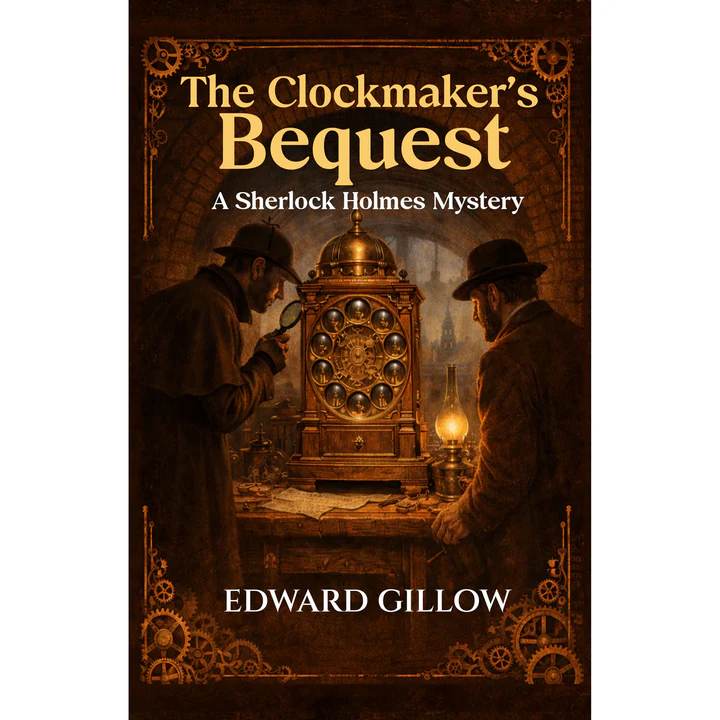
Review of Edward Gillow’s The Clockmaker’s Bequest


As Holmes and Watson languish in boredom, a telegram arrives from solicitor Phineas Larcombe, requesting Holmes’s immediate assistance. Renowned clockmaker Ezekiel Brand has died suspiciously after leaving his estate to whichever of his three apprentices can solve a riddle hidden in his final masterpiece clock.

Holmes examines the clock, which is housed in a secure vault. Since it’s light-sensitive and chimes a unique sequence of notes in darkness, Holmes deduces it’s designed to reveal a message under specific conditions rather than through physical tampering.

When one apprentice dies and another expresses fear for his own life, suspicion falls on Larcombe who may have reason to keep the clock’s secret undiscovered. In the event all apprentices die, Larcombe would become the clockmaker’s beneficiary, but Holmes suspects deeper motives driving events.

As Holmes and Watson continue to investigate, a letter arrives, warning them to abandon the investigation altogether. Instead, the duo attempt to prevent yet another murder by setting a trap for the murderer, spreading the rumor that Holmes has solved the clock’s secret, setting up the climax that unveils the murderer as well as the mastermind who set events in motion.

Author Edward Gillow perfectly captures the voice, mood, and pace of the original Holmes tales with this satisfying mystery worthy of the Baker Street detective’s expertise. The Clockmaker’s Bequest is available in hardback, paperback, digital, and audio formats from Amazon.com, other retailers, and directly from MX Publishing.

Thursday, July 9, 2026

The Further Memoirs of Sherlock Holmes Volume III, by Caiden Cooper Myles

The Further Memoirs of Sherlock Holmes Volume III, by Caiden Cooper Myles, features six new adventures and is a welcomed addition to the Holmes canon. Precisely capturing the original Holmes stories’ narrative voice and style, Myles delivers tales that not only further explore Holmes’s deductive prowess, but also celebrate his cherished relationship with John Watson.

Having finagled Holmes’s blessings to publish accounts previously forbidden, Watson recounts a half-dozen clever mysteries that include the disappearance of an Aztec statue, a mystical circle, the murder of a form
er criminal, a murdered politician, a gambler found garroted and naked in his study, and a nemesis worthy of Moriarty comparison, providing the intrigue and deductive challenges readers have come to expect Holmes and Watson to face.

Like Sir Arthur Conan Doyle’s stories, not all in this collection end neatly with the perpetrator suffering consequences for crimes committed. Holmes and Watson, to their frustration, must wait for future opportunities to serve justice even as an innocent in the meantime pays the price.

Myles has compiled a satisfying collection of tales, generously augmented with Victorian style illustrations by Marie-Charlotte Feret, that celebrate and honor Conan Doyle’s enduring legacy of “the world’s greatest detective.” The Further Memoirs of Sherlock Holmes Volume III is available in hardback, paperback, digital, and audio formats from Amazon.com, other retailers, and directly from MX Publishing.


Monday, March 20, 2023

The Bridge & Politics Published


Announcing simultaneous publication of two books, The Bridge and Politics. In late 2021, it became necessary to place all work on hold throughout 2022. I have now returned to those projects, which means more will appear in a shorter time than usual, beginning with these two collections, but I will not inundate you with emails. I hope you find the completed projects interesting and relatable.

The Bridge and Politics collect new and previously published poems that present the stories of life's common and extraordinary experiences we share in myriad ways. The books are available through most bookstores in digital and paperback formats, including Amazon, iTunes, Kobo, Barnes & Noble, and many others. You can also request your local library to purchase them through distributors such as OverDrive.

In tribute to my best friend and spouse Bonnie, I am currently posting previously published poems to FaceBook (http://facebook.com/c.s.fuqua.author), poems that will be included in an upcoming collection tentatively entitled Bonnie Lynne ~ Real Love Poems, featuring new and collected poems written for and/or inspired by Bonnie over our 5-plus decades together. Other upcoming projects include a tribute album of songs and instrumentals written for Bonnie over the years. I hope you’ll find each project a celebration of and testament to one of the most extraordinary persons ever to grace this planet.

Praise for C.S. Fuqua’s poetry:

  • C.S. Fuqua’s poetry paints an entire story with a Tom Waits brush. If you don’t know what I’m talking about, google it. ~ Ken S., editor, Spank the Carp literary magazine
  • With an eye for the particular and ear for the music of life, C.S. Fuqua shares with readers his brave, lyrical view of the human experience. ~ Dr. Wendy Galgan, former editor, Assisi Literary Magazine
  • … gritty, insightful, humorous, tragic, and celebratory … ~ Jonathan K. Rice, editor, Iodine Poetry Journal
  • C.S. Fuqua handles the themes of love and death with beautiful simplicity: what else is there to life? ~ Kalyna Review
  • …thought-provoking and interesting … ~ Suanne Schafer, author, A Different Kind of Fire
  • …a lasting impression on the reader. ~ Sensawunda
  • The power of C.S. Fuqua’s poetry lies in the relentless chronicling of real people with real sorrow, triumph, regret, and above all the sad beauty of the human experience. Superb poetry. ~ Tony Nesca, Author of About A Girl
  • Few have as deft a touch as C.S. Fuqua, weaving a complete story in just a few lines—what poetry is supposed to be. ~ Dick Claassen, Author of Sacred Native American Flute

I am grateful for your support of and interest in my work. If you have questions or concerns, please visit my websites (csfuqua.com and csfuqua.bandcamp.com) or write to me directly at fuqua.cs@gmail.com. 

I wish you and your loved ones the very best always.

Tuesday, July 19, 2022

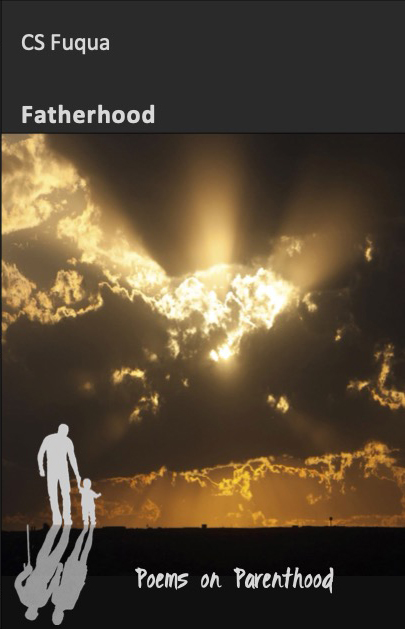
Fatherhood Explores Parenting from Dad’s Perspective

Any way you look at it, parenting is rife with challenges and joys. Fatherhood ~ Poems of Parenthood, the latest book by author/musician C.S. Fuqua, published by UK-based Stairwell Books, explores the facets of parenting from a father’s perspective in 90 poems written over a 30-year period.


In 1991, Fuqua became an “at-home dad” charged with the day-to-day care of a newborn daughter. He and his spouse Bonnie were what the media then called a new breed of parents, those who chose not to settle into traditional roles of woman-as-homemaker, man-as-breadwinner. While his wife pursued a career in public service, Fuqua established himself as a freelance writer. 

In the lean, early years of marriage, the couple had dismissed the idea of becoming parents, Fuqua said, “because we weren’t ready for parenthood—not monetarily, not intellectually, not emotionally.” By age thirty-five and their thirteenth wedding anniversary, “We’d become financially stable and decided it was time.” 

Beginning with two miscarriages, the couple found themselves on an emotional rollercoaster like they’d never experienced before, one that only intensified with the birth of their daughter. “But something magical happened,” Fuqua said. “With most of my time now devoted to her, our daughter became my primary creative muse, and I began to devote much of my writing to the exploration of parenthood—the daily experiences, insecurities, failures, successes.” 

Fuqua spent most days caring for the couple’s daughter, playing with her, taking her on exploratory walks, conversing with and reading to her as though she understood every word, involving her in social development situations, and sharing all duties with his spouse in the evenings, on weekends, and her days off—all about which he wrote in poetry, in fiction, and in journal-style letters to their daughter that he continues to write today.

In 2007, Uncial Press published a collection of 38 of Fuqua’s parenting-related poems entitled The Swing ~ Poems of Parenthood, which won the Best Poetry Collection EPIC Award for 2008 and remained in print for the next fourteen years. In 2021, Fuqua decided to expand the collection with poems he’d written since its publication, more than doubling the number of The Swing’s original poems, all of which are included in Fatherhood. 

Fatherhood chronicles 30 years of parenting experiences, from pregnancy to the child’s adulthood—the joy, sorrow, insecurity, confidence, anxiety, calm, irrationality, fear, pride, confusion, clarity, mourning, celebration, hope, and so much more—“all due,” Fuqua said, “to one extraordinary young woman who’s astounded her mom and me from day one with her intellect, humanity, and grace.”

Fatherhood ~ Poems on Parenthood is available through most bookstores and directly from Stairwell Books at https://www.stairwellbooks.co.uk/product/fatherhood/.

Fuqua has been writing professionally since 1979. His published books include White Trash & Southern ~ Collected Poems, Walking after Midnight ~ Collected Stories, Big Daddy’s Fast-Past Gadget (SF novel), Hush, Puppy! A Southern Fried Tale (children’s book), and Native American Flute ~ A Comprehensive Guide, among others. His short fiction and poetry have appeared in hundreds of national and international publications as diverse as Rattle, The Pearl, Cemetery Dance, The Christian Science Monitor, Main Street Rag, and Year’s Best Horror Stories. Learn more about his writing and music at http://csfuqua.com.